
Sports drinks: Dubai’s hydration question
TL;DR: Sports drinks can offer benefits over water during exercise in certain circumstances, not every workout; Dubai's location alone does not establish that a particular bottle suits a particular session.
Key takeaways
- The American College of Sports Medicine position stand describes conditional benefits from drinks containing carbohydrates and electrolytes, not a universal advantage over water.
- Sweat rates and sweat electrolyte content vary considerably between people, so a city-wide drinking prescription misses individual differences.
- Sugar added to a sports drink falls within the World Health Organization's definition of free sugars. A sporting purpose does not change that classification.
- A recent review of exercise-associated hyponatraemia identifies excessive fluid intake as one contributor to this potentially serious condition. More fluid is not automatically better.
Are sports drinks better than water?
Sports drinks are not universally better than water; the benefit depends on the circumstances of exercise. The American College of Sports Medicine's 2007 position stand on fluid replacement says beverages containing carbohydrates and electrolytes can provide benefits over water alone under certain circumstances.
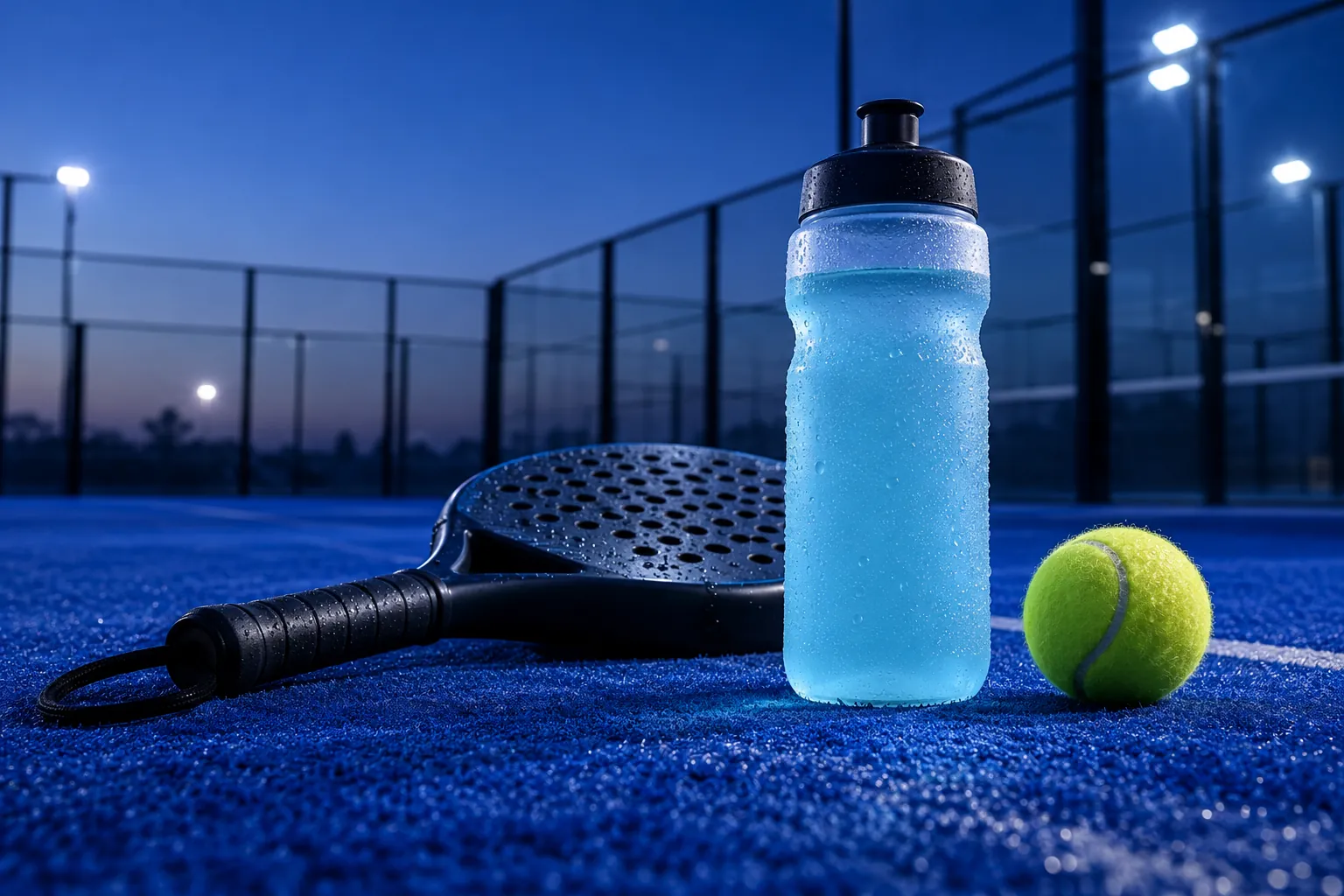
That is a narrower conclusion than an unconditional promise of better hydration or performance. It does not establish that every drink sold in Dubai improves every workout, or that every exerciser needs the same ingredients. The bottle may look ready for a triathlon. That is not evidence that the session requires one.
For a reader comparing options, the useful question is: what specific need is this product supposed to meet? An ingredient list and a clear description of the exercise are more informative starting points than the word “sport”. This is a way to assess a claim, not a personal fluid plan.
Does exercising in Dubai settle the question?
No, exercising in Dubai does not remove the individual differences that matter to fluid replacement. The sports medicine position stand explicitly notes considerable variation in both sweating rates and the electrolyte content of sweat.
Think of an indoor gym class, an outdoor padel match and an endurance event as different questions rather than one “UAE workout” category. Their shared postcode is not enough information to decide whether the same drink is appropriate. The same caution applies to comparisons across the Gulf: a location is context, not a prescription.
There is also a separate workplace issue. The Abu Dhabi Public Health Centre's Safety in Heat programme addresses heat-stress management procedures for employers and supervisors protecting workers. Its occupational focus should not be reduced to a consumer beverage choice or treated as a sports-drink endorsement.
Our editorial judgement is simple: evaluate the activity and the actual product claim separately. “Designed for the Gulf” is a marketing description unless accompanied by evidence relevant to the people and conditions in question.
Does a sporting purpose cancel the sugar?
No, sugar added to a sports drink remains free sugar under the WHO's healthy diet guidance. WHO's definition includes sugars added to foods and beverages by manufacturers, cooks or consumers.
That classification does not mean carbohydrates have no role during exercise. The sports medicine position stand describes circumstances in which carbohydrate-containing drinks can be useful. A sports-fuelling question and a general dietary question are different questions; neither is answered by treating sugar as automatically good or automatically bad.
A useful label comparison asks what the actual product contains and what the claim refers to. Does it describe carbohydrate delivery, electrolyte content or a tested performance outcome? Those are not interchangeable propositions. Attractive packaging remains impressively versatile. Scientific conclusions are less flexible.
For the separate caffeine question, our Dubai energy-drinks guide looks at that category. It is not evidence that a sports drink is necessary.
Can drinking more create a different problem?
Yes, excessive fluid intake can contribute to exercise-associated hyponatraemia, a condition involving low blood sodium around physical exertion. A peer-reviewed review published in 2026 describes a multifactorial process in which excessive intake is one contributor, rather than treating sodium loss through sweat as the whole explanation.
The review also stresses the importance of distinguishing this condition from other problems with similar symptoms. That is why an article cannot safely turn feeling unwell during exercise into a diagnosis or a recommendation to drink more, drink less or add salt. Clinical assessment is a different task from comparing a shopping label.
The practical interpretation here is deliberately limited: “more” is not a measure of suitability. This article provides no fluid volume, electrolyte dose or personalised hydration instructions.
Limitations
The exercise-and-fluid-replacement source is a professional position stand from 2007, not a new UAE trial or a test of a particular brand. The 2026 hyponatraemia paper is a clinical review, not evidence that any specific sports drink is safer or more effective.
WHO's dietary guidance addresses dietary patterns rather than an individual's training session. Abu Dhabi's heat programme concerns occupational safety, not a head-to-head comparison of sports beverages. None of these sources establishes a universal best sports drink for Dubai or the GCC.
This article cannot assess symptoms, electrolyte status, medical conditions or medicine-related restrictions. Those questions belong with an appropriately qualified healthcare professional, not a beverage ranking.
Where does mescreen™ fit?
mescreen™ is a separate wellness assessment, not a method for selecting a sports drink. The current UAE product page describes an at-home mitochondrial function assessment using a dried blood spot sample and laboratory analysis, and explicitly says it is not intended to diagnose, treat or cure a medical condition.

If you are comparing wellness assessments, read that product scope before deciding whether it matches your question. It should not be mistaken for a clinical assessment of hydration or a personalised electrolyte plan.
Sources
- American College of Sports Medicine position stand. Exercise and fluid replacement, Medicine & Science in Sports & Exercise, 2007, via PubMed
- Healthy diet, World Health Organization, 2026
- Safety in Heat, Abu Dhabi Public Health Centre
- Pathophysiology and treatment of exercise-associated hyponatremia, Journal of Endocrinological Investigation, 2026, via PubMed
- Mitochondrial Function Assessment, mescreen™ UAE